
AUTHOR: KHUSHI AGARWAL, Contributing Writer at GPC
CRITICAL ANALYSIS OF THE WORKING OF IMF
Avoiding economic and financial crises, huge fluctuations in economic activity, high inflation, and excessive volatility in foreign exchange and financial markets are all ways to promote economic stability. Instability can exacerbate uncertainty, deter investment, stifle economic progress, and wreak havoc on living standards. A dynamic market economy is characterized by a certain amount of volatility as well as steady structural change. Policymakers face a difficult task in minimizing volatility both at home and abroad without jeopardizing the economy’s ability to enhance living standards through increased productivity, employment, and long-term growth.
The IMF has been able to ameliorate the economic conditions of several countries in need. However, in some circumstances, an IMF program may transmit a negative signal about the size and nature of a country’s economic difficulties. In this case, the catalytic effect on other capital flows, especially private ones, may be adverse. This effect could then mean that, because of reduced capital inflows, IMF programs have a negative rather than a positive effect on economic growth.
THE CURRENT SITUATION
Pakistan is currently experiencing significant economic crises and may seek a $1 billion loan from the IMF, even though recent talks between Pakistan and the IMF in October were inconclusive. Last year, Pakistan received a $6 billion loan from the IMF, and the COVID 19 outbreak appears to have spurred them to seek further cash from the IMF. However, to obtain a loan from the IMF, Pakistan had to increase its already high tax rate, which, according to Dr. Arthur Laffer, harmed the country’s fragile economy even more. He has advocated for reduced tax rates, claiming that taxes are harmful to the economy and growth and that increasing taxes harms the country’s prosperity. Does the incident raise questions about the workings of the IMF since if the goal is to enhance countries’ economies, then why are there conditions attached to loans from the IMF? During India’s economic crises in 1991, similar economic constraints were imposed on the country, forcing it to implement Liberalization, Privatization, and Globalization (LPG) reforms. Although these LPG changes were mostly favorable to the Indian economy, each government retains the authority to select which reforms to pursue and when.
ANALYSING THE WORKING OF IMF
With 190 members, the IMF is one of the most influential international economic organizations. It was founded in 1994, shortly after World War II, and has 190 members. The IMF is funded by quota contributions, in which each of its members is assigned a quota based on the strength of its economy, and a member country’s quota even determines its voting rights. Larger economies have more voting rights, which is why a superpower like the US can control the IMF. Additionally, the chief of the IMF has traditionally been from Europe. The IMF’s fundamental goal is to regulate global exchange rates so that international transactions can be managed fairly. However, the fixed exchange rate system failed in 1973, and the IMF’s mission changed dramatically.
For instance, Ecuador signed a $4.2 billion loan agreement with the IMF in 2019, and the IMF, as usual, required some economic measures. These IMF criteria, according to IMF Chief, Christine Lagarde, are a “comprehensive reform agenda” aimed at modernizing the economy and driving it toward strong, sustained, and equitable growth. In practice, however, it resulted in a recession and a rise in poverty. One of the criteria was to reduce Ecuador’s budget by 6% of GDP, which necessitated raising taxes and severely cutting government spending. As a result, tens of thousands of federal employees have lost their jobs. These circumstances had an influence on the local population, and the country entered a mild recession; foreign investment dried up as a result.
Currently, the IMF is meddling in the debt management of member countries by granting them short-term loans. The IMF may help countries resolve their financial crises, but in reality, the IMF intervenes in economic decisions throughout Asia, Latin America, and Africa. It’s not that the IMF’s position has always been negative; for example, it was successful in managing the Asian Financial Crisis, but it’s been less discussed how the IMF’s interventionist strategy has affected some countries.
CONCLUSION
In his book ‘Globalization and Its Discontent,’ Nobel Laureate Joseph Stiglitz claims that the IMF is largely responsible for the failure of development of some poor countries. He claims that when the IMF lends, it does so on the condition of changes such as reduced government spending, privatization, higher interest rates, and open capital markets, thus exporting the Western model of capitalism. This approach of the IMF is also comparable to the practice of ‘neo-colonialism’ where the wealthy countries use the IMF to control and influence the economy of poorer countries. In offering loans, IMF policy does not require privatization or liberalization as a result of a novel motive, but rather the IMF is used by powerful countries to negotiate their private corporations. Rich, powerful countries typically view poor countries as ‘markets’ and ‘sources of raw materials.
These problems highlight the need for fundamental IMF reforms, in which the IMF should not only respect other countries’ sovereignty but also make the voting system more representative so that certain countries do not use their clout for personal advantage. As a global economic forum, the IMF should gain countries’ trust by altering its conditions and reducing rigorous measures that result in higher debt.
*“The views expressed in the article are author’s personal and is not endorsed by the Global Policy Consortium (GPC) or assumed by their members”

AUTHOR: TRIDIVESH SINGH MAINI, Senior Contributing Writer at GPC
WORLD COMMUNITY AND ITS RESPONSES TO AFGHANISTAN’S HUMANITARIAN CRISES
Mohammed bin Abdulrahman Al-Thani, Qatar’s foreign minister while speaking at ‘Rome MED 2021 — Mediterranean Dialogues’ flagged the severity of the humanitarian crisis in Afghanistan, and the need for the world community to help. He also said that no clarity has emerged concerning the Taliban Regime:
‘I think the situation in Afghanistan needs everybody’s help and needs the cooperation of the international community to work together collectively to help’.
The words by Qatar’s Foreign Minister came just days after French President Emmanuel Macron said during a visit to the Middle East that France and other European countries were going to establish a joint mission in Afghanistan. Macron was clear that this did not imply diplomatic recognition of the Taliban regime, and he also stated that other concerns needed to be sorted first, including the security of diplomats, before the EU could proceed.
INITIATIVES TAKEN BY THE GLOBAL COMMUNITY AND INTERNATIONAL ORGANIZATIONS TO ASSIST AFGHANISTAN
In recent months, the global community has taken note of the humanitarian crisis in Afghanistan. According to estimates, 23 million people – which amount to well over half of Afghanistan’s population – are facing extreme levels of hunger, with 9 million steering at a famine. The humanitarian crisis is only likely to get worse as the winter approaches.
At a meeting organized by the UN in September 2021, the global community committed over 1 billion USD in assistance (G7 countries along with China committed 30 million USD in the form of assistance in September 2021 (China has also resumed a direct trade link in October 2021 with Afghanistan and).In a G20 meeting in Afghanistan, the EU committed an amount of 1 billion euros to assist the country in dealing with its socio-economic challenges.
In an important development, Indian humanitarian assistance (consisting of 50,000 tonnes of wheat and drugs) has been allowed by Pakistan to transit through its territory.
In September 2021, the US treasury also issued licenses to ensure that humanitarian aid from multilateral organizations and US Charities face no problems. Recently a Taliban delegation led by Foreign Minister in the interim Taliban dispensation, Amir Khan Muttaqi met with U.S. Special Representative for Afghanistan Thomas West and discussed a wide range of issues.
The US State Department Spokesperson reiterated the US commitment to providing humanitarian assistance and underscored the point that the US Treasury had issued general licenses to facilitate the uninterrupted flow of humanitarian assistance to the people of Afghanistan.
Afghanistan is demanding the release of over 9 Billion USD of assets from the Afghan central bank (largely held in the US Federal Reserve) which were frozen by the US. The Afghan delegation during the meeting while assuring the US of rights of minorities and women and security of aid workers asked for unfreezing of assets. A statement issued by the Taliban Spokesperson said after the meeting,
‘…urge immediate unconditional unfreezing of Afghan reserves, ending of sanctions & blacklists, & disconnecting humanitarian issues from political considerations’.
China and Iran have been repeatedly supporting the demand for the release of assets. Chinese Foreign Ministry spokesperson, Lijian in a media briefing last month said that assets should be released immediately since they were worsening the humanitarian disaster and common Afghans were suffering. He also dubbed the freezing of assets as a tool of coercion.
CONCLUSION
Following the Taliban takeover, the IMF and World Bank suspended aid as well as over $300 million in reserves held by the IMF. The World Bank is attempting to give 500 million USD to humanitarian groups from a fund that was frozen, which may come as a relief to Afghanistan.
The interim Taliban government has made it clear that it wants commercial relations and connectivity with all countries, and while it has lauded China for its assistance and emphasized the importance of China’s role in the country’s economic development, it does not want to be reliant on any one country. While expressing its concerns, the international community must be pragmatic and flexible, prioritizing humanitarian issues and the welfare of the Afghan people.
To summarise, while it is critical for the Taliban to keep its promises to the international community regarding the safety of minorities and women, as well as providing representation to all communities, the international community must also take a more proactive role in assisting Afghanistan in dealing with its humanitarian crisis.
Countries, particularly the US and China, must look beyond their rivalries and avoid viewing things through a zero-sum lens. Multilateral organizations must step forward, and while words from the World Bank and the European Union are positive, more must be done. Along with the US, China, and Afghanistan’s neighbors, as well as the EU is likely to play a key role in Afghanistan’s reconstruction, particularly if a joint mission is established. While there will be plenty of opportunities for geopolitical squabbling in Afghanistan, the focus should be on humanitarian challenges for the time being.
*“The views expressed in the article are author’s personal and is not endorsed by the Global Policy Consortium (GPC) or assumed by their members”
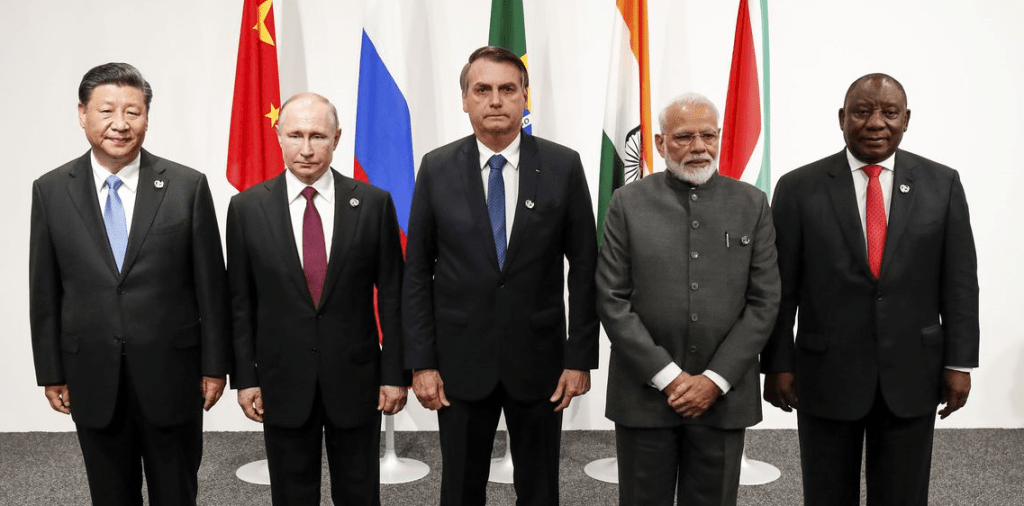
BRICS Leaders at G20 Summit Meeting in the year 2019. Image Souce: THE WIRE
AUTHOR: ADITI SHETTY, Writer at GPC
UNDERSTANDING THE ROLE OF BRICS AMIDST THE PANDEMIC
The BRICS (Brazil, Russia, India, China, and South Africa) grouping, a collection of developing political and economic powers, has been a significant factor in the global panorama. The pandemic has challenged numerous economies, global institutions, and the whole concept of multilateralism to the test, with the BRICS being no exception. BRICS was one of the first respondents to the outbreak, expressing its condolences. BRICS was one of the first organizations to respond to the pandemic, expressing sympathy, solidarity, and support for China, which had been heavily affected by COVID-19, and explicitly stating the need to strengthen scientific cooperation in combating infectious diseases and bolstering the pillar of public health. As early as February 2020, during the BRICS Sherpa meet, the BRICS had raised alarms about the COVID-19 pandemic.
The BRICS witnessed tensions among its member states that have harmed the organisation’s functioning, such as cross-border violence between India and China, which only ended after eight months of talks with both sides disengaging soldiers, severing Sino-Indian ties. Even Brazil’s President Jair Bolsonaro’s preferences for the United States and criticism of China have blamed on increasing conflict inside the organisation, among other things. Moving forward, the BRICS will face hurdles in realising their full potential. Despite the fact that it has been met with distrust since its inception, the BRICS has established itself as a formidable force against those who made an attempt to question its credibility.
THE ORIGIN
The BRICS grouping is accredited to Jim O’ Neill, who was then the Chief Economist at Goldman Sachs, a prestigious global financial bank. As he put it after the 9/11 attacks, “What 9/11 told me was that there was no way that globalization was going to be Americanisation in the future – nor should it be.”
The first BRIC summit, which included the four BRIC foreign ministers, was held seven years after Jim O’Neill published his papers on the BRICS in 2001. In May of the following year, the chiefs of state of the BRIC countries met in Russia. South Africa began the process of joining the grouping a year later and became an official member a year later.
The BRICS nations account for 42% of the global population and nearly 23% of global GDP; however, unlike other groupings such as ASEAN, which is geographically linked, or the G7, which brought together some of the world’s most developed countries, the BRICS’ homogeneity is unclear, and they are geographically dispersed. The economic gaps have added to the divisiveness, with China being the only country in the world to see economic growth by 2020, while others are still reeling from the pandemic’s aftermath, with worrying contractions, and the members’ far-flung locations have only hampered trade accords.
The international outcry against China for failing to alert the world about the fatal disease and for being unable to quickly contain the virus’s spread, resulting in Brazil, India, and South Africa becoming significant virus hotspots. Russia has also been severely damaged by the COVID-19 outbreak, which has exacerbated the country’s economic challenges as it battles European Union sanctions by the European Union and the United States as a result of its invasion of Crimea. It is clear that each country’s response to the pandemic and its aftermath has been unique.
BRICS AMIDST THE PANDEMIC
BRICS aims to put the tides of time and COVID-19 to the test in the midst of the global crisis. Brazil’s president, Jair Bolsonaro, has been condemned for his slow response and ineptitude, as the country is responsible for 11% of COVID-19-related deaths globally. China has been accused of being coy about the virus’s dangers, while India’s victory narrative over the virus has devolved into a deadly second wave, with WHO Director-General Tedros Adhanom Ghebreyesus issuing a warning to the country on May 14, 2021, “India remains hugely concerning, with several states continuing to see a worrying number of cases, hospitalizations, and deaths.” South Africa was the worst-affected economy on the continent; the six-week shutdown, while beneficial, had a negative impact on the working poor, who resorted to rioting as a result of various measures, such as the delivery of food packs and other help, failing to reach the intended recipients.
In troubled periods, the BRICS convened on multiple occasions in 2020, with over 150 activities and 25 ministerial-level meetings. As the BRICS nations’ economic gaps widened, the New Development Bank of the BRICS offered financial assistance. The New Development Bank, led by KV Kamath, determined in April 2020 at its Governors body meeting that China would receive $1 billion in loans, which would subsequently be distributed to other member countries. This action has set a precedent for a number of international organizations to begin providing much-needed financial assistance.
The BRICS countries actively collaborated with the WHO, Europe, and others to provide Human Aid and Disaster Relief (HADR). The BRICS Economic Partnership, which will run until 2025, is also aimed at reviving the economies of countries that have suffered greatly as a result of the pandemic. BRICS countries have formed collectives to support women in business, combat terrorism, and coordinate research efforts in the field of energy management, among other vital topics.
CONCLUSION
One of the most important contributions BRICS countries can make to help the global economy recover is to start rebuilding global value chains. Mutual investment and support to establish value chains across BRICS countries will help the global economy while also enhancing BRICS countries’ networks. BRICS countries may mobilize their combined 40 % of global population, $4 trillion in reserves, and share of over 17 % of global commerce by aggressively working to reintegrate production networks and boost the openness of international trade. Global value chains also have a significant impact on employment creation, which is critical for the recovery of the economy following the pandemic. It is imperative to note that the world of pandemics and post-pandemic presents both obstacles and chances for BRICS to emerge as a strong bloc. It may use its diversity to strengthen its position and make an influence on the world stage.
*“The views expressed in the article are author’s personal and is not endorsed by the Global Policy Consortium (GPC) or assumed by their members”
A DECAYING FEDERALISM IN THE FACE OF THE COVID-19 PANDEMIC?
AUTHOR: AKANKSHA TIWARI, Writer at GPC
Federalism is a political system of governance that separates power between the union, state, and local levels of administration. The jurisdiction and responsibilities shared in this two-tier system are independent of each other. The Central government looks into issues of national concern, whereas the state and local governments focus on the day-to-day activities and domestic functioning of their particular state. Furthermore, the Central government enacts laws for the nation as a whole, and the State Legislatures enact laws for their respective states. However, Indian Federalism has been designed based on the inherent bias in the Indian Constitution to consign more power to the Union Government than the states. Therefore, it said that India is a quasi-federal country. Dr. D.D Basu describes the Constitution of India as neither purely federal nor unitary, but as a combination of federal and unitary systems.
After witnessing two hundred years of colonial rule and remembering the freedom struggle, the national movement, partition of the country, and the spread of communal violence the leaders of independent India decided to strengthen the Union Legislature because of their fear of further disunity and secessionist tendencies in the country. Jawaharlal Nehru believed that it was essential to provide the Central Government with more power as it is largely responsible for “ensuring peace and coordinating vital matters of common concern” in the international arena.
However, for ages, the provision of a powerful center has only been misused by the ruling party. The decade of the ’70s witnessed a major political crisis, resentment, agitations, and violence in Punjab, Assam, Kashmir, and Mizoram due to centralization by the Union government. The excessive use of Art. 356 of the Indian Constitution by Prime Minister Indira Gandhi to replace state governments led by opposition parties with Congress governments gave rise to the conflictual nature of federalism in India. Moreover, the abrogation of Arts. 370, 35A of the Constitution and bifurcating the state of Jammu and Kashmir (J&K), changing the political status of Kashmir, demonetization, and the passing of the Citizenship Amendment Act (CAA) 2019 by the Bharatiya Janata Party, has made the pattern of centralizing tendencies of the dominant national ruling party very clear.
The relationship between the Centre and the states has only gotten worse during the pandemic. The upsurge in Covid-19 cases has not only crippled the states but has also exposed the failure of our healthcare system. Maharashtra and Delhi have been the victims of highly politicized and unfair treatments by the Centre due to the difference of parties in power. Delhi was denied a sufficient supply of oxygen and its demand of 700 MT had been reduced to 480 MT, but states with fewer cases were provided with more. Several allegations on stealing oxygen tankers by the Delhi government were made by the Haryana Health Minister Anil Vij. These allegations were soon dismissed when Delhi hospitals claimed that Linde India limited, their supplier of oxygen from the Faridabad plant, had terminated the supply of oxygen outside the boundaries of the state following the orders of the Haryana state government. Furthermore, the court orders issued against the center for cutting down oxygen supplies in the State have caused nothing but havoc. Delhi High Court decided to issue contempt action against the officials of the central government if their demand for 700 metric tonnes was not met. As a result, 730.7 MT of oxygen was released to Delhi on 5 May by cutting down supplies from elsewhere. Rajasthan health minister pointed out that the state has received 200 MT less than what they were allotted and Jharkhand, the producer state, too complained about the shortages in six districts. It is crucial for the states to refrain from hoarding supplies and seeking court redressal to pressure the Centre. It only causes inconveniences faced by different state governments and stiff competition among each other.
The government’s carelessness exacerbated the public health crisis, resulting in a severe lack of essential medicines, vaccines, oxygen cylinders, hospital beds, doctors, ambulances, and cremation spaces. This mayhem allowed for a growth in the capitalization of basic supplies, black-marketing, and a general disregard for the poor’s plight.
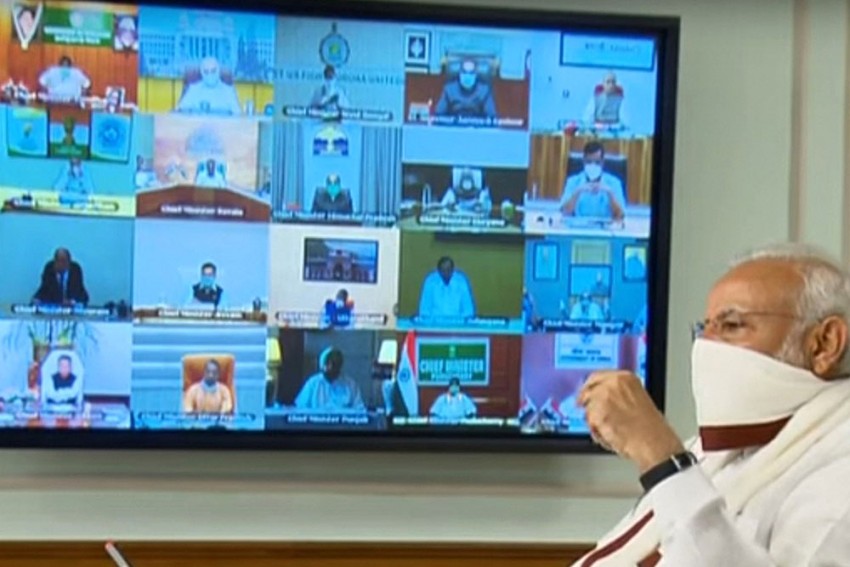
The initial periods of lockdown highlighted complete centralization by invoking the Epidemic Diseases Act and Disaster Management Act. Prime Minister Narendra Modi decided to impose the most severe lockdown without consulting the states or considering the ramifications. The lack of accountability on behalf of the government forced the poor workers to migrate either through their private vehicles or, in most cases, by foot. Despite the fact that many people died on their way home, the state showed no mercy. This clearly demonstrated the inadequacy of all three constituent divisions of the government to respond to citizens’ needs, throwing light on the flawed cooperative federalism in India. Although the distribution of vaccines remains highly politicized, the second wave did notice decentralization of power. The Centre was supposed to be the single entity in charge of monitoring vaccine production and ensuring equal distribution of vaccines, regardless of which political party was in power. Regardless of whose party was in power, the Centre was intended to be the only institution in charge of monitoring vaccine production and ensuring equitable distribution of vaccines. However, in response to mounting criticism from several state governments, the Centre abruptly decided to consign the states with the responsibility of procuring and administering the distribution of the vaccine for people below the age of 45 years. Because of this sudden shift in responsibility, state governments failed to fulfill their duties. The new vaccination policy obviously attempted to place the burden of acquiring vaccinations directly from the producers on the states, which resulted in disparities in price setting. The Centre, understandably, blamed the state governments for mismanaging and mishandling the operation, which intensified the already strained relationship between the two.
The shift in the dynamics from centralization to decentralization by the Centre during the pandemic has been very irresponsible. It completely disregarded its role as an accountable governing body. The unprecedented health and the financial hazard posed by the pandemic has not only affected the socio-economic conditions but also acted as a catalyst in decaying an already sinking center-state relation thereby, amplifying the public health crisis. In dire times like this, the Centre should not hop onto opportunities to toss the blame rather it must coordinate and collaborate with its subordinate bodies. The center must not see it as a competition but as a co-operation.
For quite a period of time, the Union Administration has been abusing its powers to dismiss State Governments that are controlled by opposition parties. But the current situation demands that the system goes beyond cooperative federalism and adopts a more egalitarian approach that would not only benefit the Centre but also help in the holistic development of the states. The state and center must join hands to provide aid to the needy and fulfill their role as judicious and accountable institutions.
*“The views expressed in the article are author’s personal and is not endorsed by the Global Policy Consortium (GPC) or assumed by their members”
 Global Policy Consortium