A DECAYING FEDERALISM IN THE FACE OF COVID-19?

AUTHOR: AKANKSHA TIWARI, Writer at GPC

Federalism is a political system of governance that separates power between the union, state, and local levels of administration. The jurisdiction and responsibilities shared in this two-tier system are independent of each other. The Central government looks into issues of national concern, whereas the state and local governments focus on the day-to-day activities and domestic functioning of their particular state. Furthermore, the Central government enacts laws for the nation as a whole, and the State Legislatures enact laws for their respective states. However, Indian Federalism has been designed based on the inherent bias in the Indian Constitution to consign more power to the Union Government than the states. Therefore, it said that India is a quasi-federal country. Dr. D.D Basu describes the Constitution of India as neither purely federal nor unitary, but as a combination of federal and unitary systems.

After witnessing two hundred years of colonial rule and remembering the freedom struggle, the national movement, partition of the country, and the spread of communal violence the leaders of independent India decided to strengthen the Union Legislature because of their fear of further disunity and secessionist tendencies in the country. Jawaharlal Nehru believed that it was essential to provide the Central Government with more power as it is largely responsible for “ensuring peace and coordinating vital matters of common concern” in the international arena.

However, for ages, the provision of a powerful center has only been misused by the ruling party. The decade of the ’70s witnessed a major political crisis, resentment, agitations, and violence in Punjab, Assam, Kashmir, and Mizoram due to centralization by the Union government. The excessive use of Art. 356 of the Indian Constitution by Prime Minister Indira Gandhi to replace state governments led by opposition parties with Congress governments gave rise to the conflictual nature of federalism in India. Moreover, the abrogation of Arts. 370, 35A of the Constitution and bifurcating the state of Jammu and Kashmir (J&K), changing the political status of Kashmir, demonetization, and the passing of the Citizenship Amendment Act (CAA) 2019 by the Bharatiya Janata Party, has made the pattern of centralizing tendencies of the dominant national ruling party very clear.

The relationship between the Centre and the states has only gotten worse during the pandemic. The upsurge in Covid-19 cases has not only crippled the states but has also exposed the failure of our healthcare system. Maharashtra and Delhi have been the victims of highly politicized and unfair treatments by the Centre due to the difference of parties in power. Delhi was denied a sufficient supply of oxygen and its demand of 700 MT had been reduced to 480 MT, but states with fewer cases were provided with more. Several allegations on stealing oxygen tankers by the Delhi government were made by the Haryana Health Minister Anil Vij. These allegations were soon dismissed when Delhi hospitals claimed that Linde India limited, their supplier of oxygen from the Faridabad plant, had terminated the supply of oxygen outside the boundaries of the state following the orders of the Haryana state government. Furthermore, the court orders issued against the center for cutting down oxygen supplies in the State have caused nothing but havoc.  Delhi High Court decided to issue contempt action against the officials of the central government if their demand for 700 metric tonnes was not met. As a result, 730.7 MT of oxygen was released to Delhi on 5 May by cutting down supplies from elsewhere. Rajasthan health minister pointed out that the state has received 200 MT less than what they were allotted and Jharkhand, the producer state, too complained about the shortages in six districts. The states must refrain from hoarding supplies and seeking court redressal to pressure the Centre. It only causes inconveniences faced by different state governments and stiff competition among each other.

The government’s carelessness exacerbated the public health crisis, resulting in a severe lack of essential medicines, vaccines, oxygen cylinders, hospital beds, doctors, ambulances, and cremation spaces. This mayhem allowed for a growth in the capitalization of basic supplies, black-marketing, and a general disregard for the poor’s plight.

The initial periods of lockdown highlighted complete centralization by invoking the Epidemic Diseases Act and Disaster Management Act. Prime Minister Narendra Modi decided to impose the most severe lockdown without consulting the states or considering the ramifications. The lack of accountability on behalf of the government forced the poor workers to migrate either through their private vehicles or, in most cases, by foot. Although many people died on their way home, the state showed no mercy. This clearly demonstrated the inadequacy of all three constituent divisions of the government to respond to citizens’ needs, throwing light on the flawed cooperative federalism in India. Although the distribution of vaccines remains highly politicized, the second wave did notice decentralization of power. The Centre was supposed to be the single entity in charge of monitoring vaccine production and ensuring equal distribution of vaccines, regardless of which political party was in power. Regardless of whose party was in power, the Centre was intended to be the only institution in charge of monitoring vaccine production and ensuring equitable distribution of vaccines. However, in response to mounting criticism from several state governments, the Centre abruptly decided to consign the states with the responsibility of procuring and administering the distribution of the vaccine for people below the age of 45 years. Because of this sudden shift in responsibility, state governments failed to fulfill their duties. The new vaccination policy obviously attempted to place the burden of acquiring vaccinations directly from the producers on the states, which resulted in disparities in price setting. The Union Government, understandably, blamed the state governments for mismanaging and mishandling the operation, which intensified the already strained relationship between the two.

The shift in the dynamics from centralization to decentralization by the Central Government during the pandemic has been very irresponsible. It completely disregarded its role as an accountable governing body. The unprecedented health and the financial hazard posed by the pandemic has not only affected the socio-economic conditions but also acted as a catalyst in decaying an already sinking center-state relation thereby, amplifying the public health crisis. In dire times like this, the Centre should not hop onto opportunities to toss the blame rather it must coordinate and collaborate with its subordinate bodies. The center must not see it as a competition but as a co-operation.

For quite a time, the Union Administration has been abusing its powers to dismiss State Governments that are controlled by opposition parties. But the current situation demands that the system goes beyond cooperative federalism and adopts a more egalitarian approach that would not only benefit the Center but also help in the holistic development of the states. The state and center must join hands to provide aid to the needy and fulfill their role as judicious and accountable institutions.

*“The views expressed in the article are author’s personal and is not endorsed by the Global Policy Consortium (GPC) or assumed by their members”
UNDERSTANDING THE ROLE OF BRICS AMIDST THE PANDEMIC

AUTHOR: ADITI SHETTY, Writer at GPC

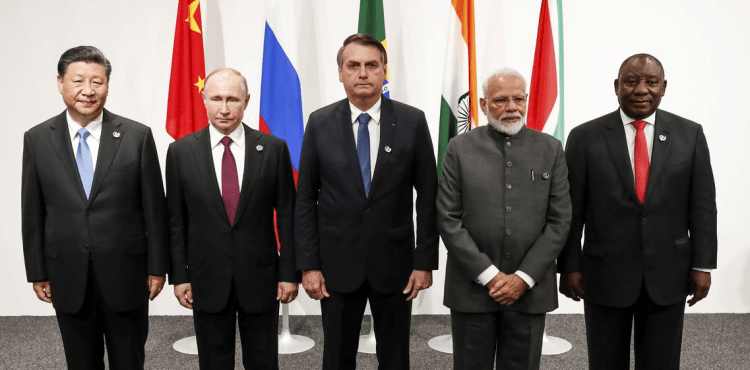
The BRICS (Brazil, Russia, India, China, and South Africa) grouping, a collection of developing political and economic powers, has been a significant factor in the global panorama. The pandemic has challenged numerous economies, global institutions, and the whole concept of multilateralism to the test, with the BRICS being no exception. BRICS was one of the first respondents to the outbreak, expressing its condolences. BRICS was one of the first organizations to respond to the pandemic, expressing sympathy, solidarity, and support for China, which had been heavily affected by COVID-19, and explicitly stating the need to strengthen scientific cooperation in combating infectious diseases and bolstering the pillar of public health. As early as February 2020, during the BRICS Sherpa meet, the BRICS had raised alarms about the COVID-19 pandemic.

The BRICS witnessed tensions among its member states that have harmed the organization’s functioning, such as cross-border violence between India and China, which only ended after eight months of talks with both sides disengaging soldiers, severing Sino-Indian ties. Even Brazil’s President Jair Bolsonaro’s preferences for the United States and criticism of China have been blamed for increasing conflict inside the organization, among other things. Moving forward, the BRICS will face hurdles in realizing their full potential. Despite the fact that it has been met with distrust since its inception, the BRICS has established itself as a formidable force against those who made an attempt to question its credibility.

THE ORIGIN

The BRICS grouping is accredited to Jim O’ Neill, who was then the Chief Economist at Goldman Sachs, a prestigious global financial bank. As he put it after the 9/11 attacks, “What 9/11 told me was that there was no way that globalization was going to be Americanisation in the future – nor should it be.”

The first BRIC summit, which included the four BRIC foreign ministers, was held seven years after Jim O’Neill published his papers on the BRICS in 2001. In May of the following year, the chiefs of state of the BRIC countries met in Russia. South Africa began the process of joining the grouping a year later and became an official member a year later.

The BRICS nations account for 42% of the global population and nearly 23% of global GDP; however, unlike other groupings such as ASEAN, which is geographically linked, or the G7, which brought together some of the world’s most developed countries, the BRICS’ homogeneity is unclear, and they are geographically dispersed. The economic gaps have added to the divisiveness, with China being the only country in the world to see economic growth by 2020, while others are still reeling from the pandemic’s aftermath, with worrying contractions, and the members’ far-flung locations have only hampered trade accords.

The international outcry against China for failing to alert the world about the fatal disease and for being unable to quickly contain the virus’s spread, resulting in Brazil, India, and South Africa becoming significant virus hotspots. Russia has also been severely damaged by the COVID-19 outbreak, which has exacerbated the country’s economic challenges as it battles European Union sanctions by the European Union and the United States as a result of its invasion of Crimea. It is clear that each country’s response to the pandemic and its aftermath has been unique.

BRICS AMIDST THE PANDEMIC

BRICS aims to put the tides of time and COVID-19 to the test in the midst of the global crisis. Brazil’s president, Jair Bolsonaro, has been condemned for his slow response and ineptitude, as the country is responsible for 11% of COVID-19-related deaths globally. China has been accused of being coy about the virus’s dangers, while India’s victory narrative over the virus has devolved into a deadly second wave, with WHO Director-General Tedros Adhanom Ghebreyesus issuing a warning to the country on May 14, 2021, “India remains hugely concerning, with several states continuing to see a worrying number of cases, hospitalizations, and deaths.” South Africa was the worst-affected economy on the continent; the six-week shutdown, while beneficial, had a negative impact on the working poor, who resorted to rioting as a result of various measures, such as the delivery of food packs and other help, failing to reach the intended recipients.

In troubled periods, the BRICS convened on multiple occasions in 2020, with over 150 activities and 25 ministerial-level meetings. As the BRICS nations’ economic gaps widened, the New Development Bank of the BRICS offered financial assistance. The New Development Bank, led by KV Kamath, determined in April 2020 at its Governors body meeting that China would receive $1 billion in loans, which would subsequently be distributed to other member countries. This action has set a precedent for a number of international organizations to begin providing much-needed financial assistance.

The BRICS countries actively collaborated with the WHO, Europe, and others to provide Human Aid and Disaster Relief (HADR). The BRICS Economic Partnership, which will run until 2025, is also aimed at reviving the economies of countries that have suffered greatly as a result of the pandemic. BRICS countries have formed collectives to support women in business, combat terrorism, and coordinate research efforts in the field of energy management, among other vital topics.

CONCLUSION

One of the most important contributions BRICS countries can make to help the global economy recover is to start rebuilding global value chains. Mutual investment and support to establish value chains across BRICS countries will help the global economy while also enhancing BRICS countries’ networks. BRICS countries may mobilize their combined 40 % of global population, $4 trillion in reserves, and share of over 17 % of global commerce by aggressively working to reintegrate production networks and boost the openness of international trade. Global value chains also have a significant impact on employment creation, which is critical for the recovery of the economy following the pandemic. It is imperative to note that the world of pandemics and post-pandemic presents both obstacles and chances for BRICS to emerge as a strong bloc. It may use its diversity to strengthen its position and make an influence on the world stage.

*“The views expressed in the article are author’s personal and is not endorsed by the Global Policy Consortium (GPC) or assumed by their members”

What is Global Policy Consortium About?

The primordial aim of Global Policy Consortium (GPC) is to provide a platform for professional practitioners and academicians to collaborate and engage in a meaningful policy research dialogue. This platform aims to dilute the delineation that exists in theory and practice and provides an engagement that will enable to widen the horizon of policy-making existing in professional fields and academia.

What do we publish?

Global Policy Consortium currently aims at publishing academic articles including policy briefs, reflections, commentaries and dialogues from various disciplines of science and social science. Students pursuing under-graduation, post-graduation or enrolled in higher education (M.phil/Ph.D) along with professional practitioners can contribute articles. Currently we are accepting articles from the following fields

Political Science

Public Policy

International Relations

Security Studies

Gender Studies

Area Studies

Public Health

Environmental Science

Geography

Law

Economics

Journalism

Management

Public Administration

Sociology

Anthropology

English

History

Archaeology