AUTHOR: AKHILA KUMARAN
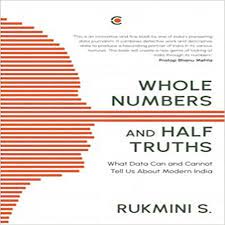
In the book Data Feminism by Catherine D’Ignazio and Lauren Klein, the authors elaborate on the myth of ‘neutrality of data’ and the need for the same stating “the plainer, the more neutral; the more neutral, the more objective; and the more objective, the more true— or so this line of reasoning goes.” (Kindle Location 1574-1575: 2020) D’Ignazio and Klein go on to state how this is deeply problematic and in fact, is largely untrue, as neutral data is a term that has been a by-product of racist, sexist and eugenic philosophy, and data is in fact, situated and context-specific. While Whole Numbers and Half-Truths concentrates more on how data is analyzed rather than on data per se, the ten chapters styled as ten major questions about India help understand how(and how many) false narratives have been created based on the claim that “data is neutral”. For example, beginning with the chapter on crime statistics titled ‘How India Tangles With Cops And Courts’ the author points out how crime statistics in India need a near-complete overhaul when the conventional wisdom is that low figures mean there is less crime when in reality, the low figures only mean low reporting of crime. Under such circumstances, it would be easy to presume that states like Kerala and Tamizh Nadu are worse off in terms of the number of crimes committed when compared to other states like Uttar Pradesh or Biharwhen in reality, what occurs is the conflating State’s ability to report numbers to the incidence of crimes.
Taking the argument further to the issue of health and particularly the pandemic, if one were to look at data devoid of the context (under which most reporting takes place) it would be easy to presume that few states were contributing to the majority of cases being reported. However, the larger number of cases is (again) indicative of better reporting. In the case of the covid, this point became debatable as, over the course of the pandemic, with the work of the author ( among others) when the excess mortality figures among states reporting low Covid cases were found to be significantly higher than those in states reporting higher Covid cases.
The impact of such (mis) reporting is the very real consequences it has on the lives of the people. The perception that a particular place is dangerous based on only higher reported crime rates further discourages people from venturing there or it can lead to popular misconceptions such as the place and the inhabitants being labeled as ‘dangerous’ or even under circumstances enhance surveillance. The larger point being, in undertaking a reading of data, it is perhaps more necessary than ever before to keep in mind “..that statistics alone don’t tell us everything. They need context, an interpretation that’s free from ideological spin, and to be held up to the light.” (p. 7 Kindle Edition: 2021)
A recurring theme across several chapters – such as the one on what Indians eat or whom Indian love and marry and even how Indian vote, has been that of the effect of the harmful rhetoric on minority communities in India- particularly Muslims. The issue of population is another data story that needs to be analyzed without an ideological spin. This assumes significance in the wake of increasing anti-Muslim sentiment in the country with Muslims being blamed for a variety of reasons from increasing population to the rapid spread of the pandemic so much so that international organizations and civil society activists have alerted to the possibility of genocide in India. With respect to population, by posing the question of ‘How is India Growing and Ageing?’ the author brings to light the ineffectiveness of the coercive state policies regarding population control (2 child norm, for example)that affect the poorer communities in the country negatively, and showcases how, despite harmful rhetoric, education and income provided the necessary agency for women – from all religious community and this, eventually, led to better regulation of population growth. The chapter also shows how the fertility transition has been much more rapid than anticipated with Census 2011 showing many states showing fertility levels below replacement level. However, even as myths are repelled, it is worthwhile to examine how certain proofs are offered and by whom i.e. the burden of proof falls squarely on the communities that are suffering and therefore, in what manner are we persuading those who propagate hate? Again, reverting to Data Feminism and the principle of challenging power through data as well as bringing to light the issue of harm done through rhetoric, one can examine who needs to offer the proof of the statistic of falling fertility of Muslim women in order to convince that the Muslim population still remains minority compared to Hindus? The burden of proof, as well as the need for proof, are both inherently laced with bigotry. Perhaps, this aspect of data has been overlooked in the book.
Examining the rhetoric – whether based on bigotry (Muslims contribute to population explosion in India) or simply misguided ( ‘Younger Indians are more liberal’ )through data makes the book, in my opinion, a valuable contribution to scholarship on social justice. Another reason that makes the book such an enjoyable read has been that it never leaves the core argument being made without bringing in the real context and experiences of the people. For example, when confronted with the extremely disappointing statistic of inter-caste marriages, a young person remarks that the data is only on marriages and not on love, pointing out that perhaps there is hope to be kept on the numbers that we do not actually collect data on love or relationships.
Written in lucid prose and filled with anecdotes that serve as probable questions for further research, the book is a must-read for everyone concerned about India’s stories through data.
*“The views expressed in the article are author’s personal and are not endorsed by the Global Policy Consortium (GPC) or assumed by their members”
 Global Policy Consortium