AUTHOR: GANDHALI BHIDE, Contributing Writer at GPC
The term international peace conjures up certain preconceived ideas that broadly follow a notion of change. It strives to provide a humane alternative to conflicts, wars, and violence. In this essay I attempt in navigating the concept of ‘narrative change’, taking war museums as a model. According to ICOM Statutes, adopted by the 22nd General Assembly, museums are defined as a non-profit, permanent organization in the service of the society and its development, open to the public, which acquires, conserves, researches, communicates, and exhibits the tangible and intangible heritage of humanity and its environment for education, study and enjoyment. Simply put, museums are representations. A fundamental feature of such representation is a narrative. Narratives are not truths; they nudge you to understand the truth in a particular way. They are socially constructed, never neutral, but strategic. Even if war museums feature exhibitions and presentations on destruction, loss, and bloodshed which was the result of war, it silently maintains an undertone of a zero-sum game, i.e., a narrative of winners and losers. But is there a winner in a war?
A NEED FOR NARRATIVE CHANGE
I argue that a change in names, and the way of understanding history, especially war, through peace museums instead of war museums will usher a small, even one that seems insignificant change, towards international peace. This can be done from a more bottom-up approach where local/regional and even national museums can campaign towards re-introducing war museums as peace museums, becoming mediums of understanding, and commenting on the futility of war rather than winners of the war. History is closely linked with memory, as professor Aleida Assmann states, “Memory complements history, history corrects memory”. Simply put by changing the way we understand historical events of war can have an influence on our memories.
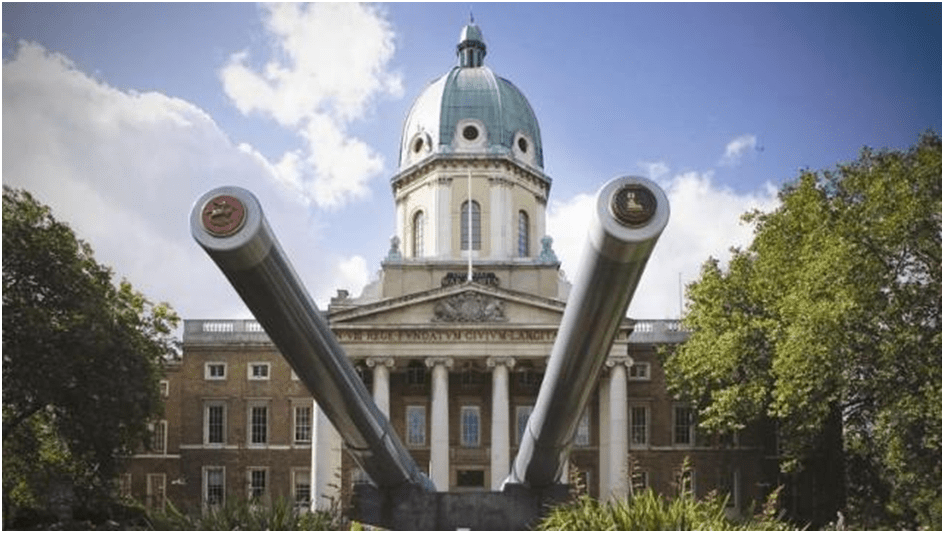
I particularly remember my second visit to London’s Imperial War Museum, in December 2019, a week before Christmas. A special exhibition was hosted for children, called Christmas during the war. Through different stalls like ‘Christmas food during the war’, ration system, listening to the radio, the museum volunteers and staff showcased those bygone periods of war. Parents and grandparents encouraged their children to be part of it. The gift shop had a special counter dedicated to ‘Christmas during the war’. The horrified realities were mellowed down to interest the next generations, to know what the war was like on the home front. The atmosphere was joyous, contrary to the emotions one associates with the term ‘war’. The kids gathered around different stalls surrounded by war aircraft like Supermarine Spitfire (British fighter aircraft during World War II), V1 Flying bomb and V2 rocket (German long-range weapons), Nery Gun (British 13-pounder gun and limber), T-34 Tank (Soviet tank design, built-in 1954) among others. It was this experience that made me reflect on the ways in which mine, as well as the future generation, are going to understand history.
Museums today are not only places for preserving history and art but are increasingly becoming tourist attractions, transforming them from local or national into the international arena. They come under what is termed as culture and heritage tourism. While it is important to know one’s history, including war, the medium of understanding can ensure that it is not repeated. Today, war museums keep reminding if not glorify the war that was won. I believe changing narratives from war to peace museums from a bottom-up approach can have another implication. The effects of such change in narrative can be quantitively measured locally and can have a greater probability of being effective. In addition, this can become a global phenomenon by bringing a narrative change locally that re-introduces war as peace museums with a new way of understanding war history.
CONCLUSION
Coming from a developing economy such as India, I am aware of one major bifurcation in approaching conflicts/war that can be understood from a broader Asian vs. European/western perspective. Asians due to their philosophy and community culture, strongly emphasize conflict avoidance rather than conflict resolution which has a more western connotation attached to it. Each local and national museum can present its culture and society-specific ways of avoiding war in these exhibitions. Let there are be a healthy competition between the different ways of avoiding war. Avoiding war does not always mean peace but I think it is the first step towards peace. For example, the concept of national borders when viewed from an Asian perspective seems crucial for peace. For Asian countries, respecting each other’s nation-state borders is a symbol of respecting each other’s sovereignty and territorial integrity, and is seen as a path to cooperation. Therefore, borders are the norm for peace in the Asian context. On the other hand, due to European Union, borders have virtually vanished in Europe and borderless Europe implies cooperation and a way towards peace. Thus, bringing in different narratives on the peace that are culturally and geographically dictated can be one of the exhibitions in these peace museums where the audience understands the other.
Peace museums, therefore, accompany an alternative model for war museums that rest on the premise of the need for narrative change in understanding the happenings of the past including war.
*“The views expressed in the article are author’s personal and is not endorsed by the Global Policy Consortium (GPC) or assumed by their members”
 Global Policy Consortium